

The fully automatic cell analyzer is one of the widely used instruments in hospital clinical testing, used to detect items such as red blood cells, hemoglobin, white blood cells, and platelets. Based on optical principles and image analysis technology, it captures cell images through optical lenses and cameras, and utilizes a computer system for data processing and analysis, achieving the identification, counting, and analysis of cells. At the same time, through internet connectivity and interactive touch screens, it can realize functions such as online information sharing.
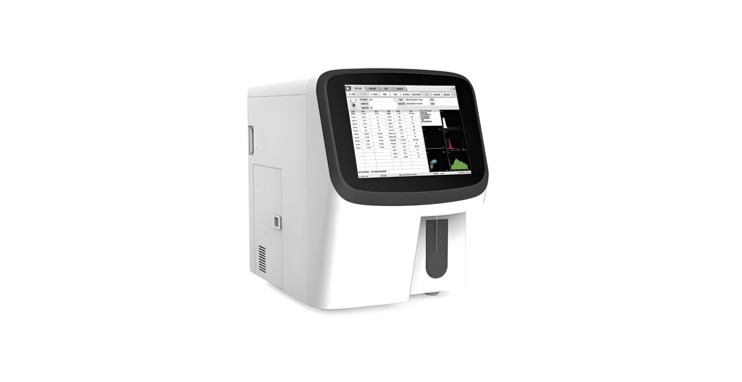
The functional system of a fully automated hematology analyzer can be divided into a signal processing system, a drive control system, and a main control system. These major systems serve as bridges connecting the entire machine and are directly related to the mechanics, software, and fluid circuits.
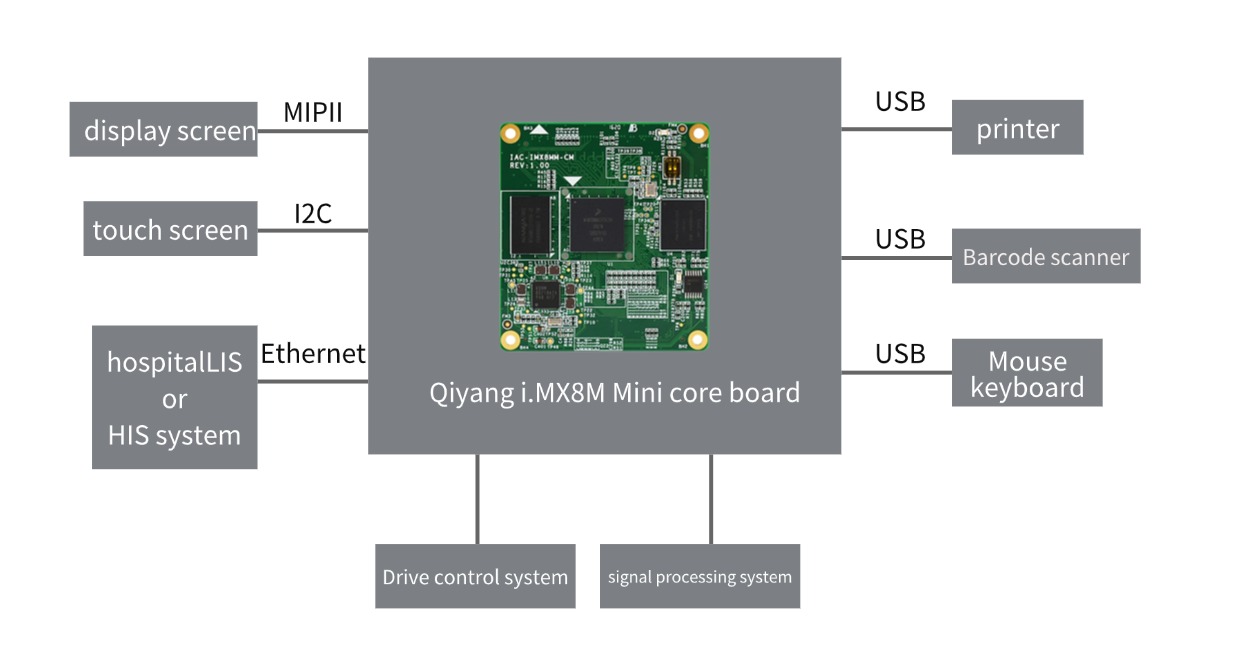
The main control system, as the core of the entire system, can send control instructions to the drive control system, which controls the operation of peripherals such as motors, solenoid valves, and pumps. On the other hand, it sends acquisition instruction signals to the signal control system for data acquisition. After data acquisition and processing, the data is uploaded to the main control system for data processing and analysis. The analysis results can be displayed and printed through the touch display system, and uploaded to the hospital's LIS or HIS system.
The main control system can be implemented using the QiYang i.MX8M Mini core board, which is based on the NXP i.MX8M Mini high-performance processor. It features a built-in quad-core Cortex-A53 and a single-core Cortex-M4, with a running speed of up to 1.8 GHz. It provides excellent data processing capabilities, sensor data detection, and real-time control functions, meeting the needs of the main control system for data processing, task scheduling, real-time peripheral driving, and detection and acquisition of data.
Supporting a four-channel MIPI-DSI display interface, integrating 2D and 3D GPU graphics accelerators, it can connect to high-definition display screens, providing clear and detailed image presentation. With powerful image processing and computing capabilities, it can quickly process a large amount of cell image data and enable human-computer interaction on the main control panel.
Supporting Wi-Fi, 3G/4G wireless communication, it achieves functions such as remote data transmission, data sharing and collaboration, remote control, and monitoring, enhancing the convenience, flexibility, and efficiency of the fully automated cell analyzer.
It boasts a wealth of interface resources, enabling connectivity with devices such as barcode printers, scanners, mice, keyboards, and thermal printers. This facilitates sample identification and management, data input and output, user interaction and operation, thereby meeting the flexibility and functionality requirements of fully automated cell analyzers.
The core board utilizes industrial-grade electronic components, ensuring long-term stable operation of the fully automated cell analyzer and guaranteeing the reliability and safety of the equipment.

