

For the elderly and individuals with disabilities, traditional electric wheelchairs offer only basic mobility functions without autonomous obstacle avoidance, navigation, and often feature complex controls. This leaves many users dependent on caregivers for outdoor travel and medical visits, with limited independent mobility and increased risk of accidents.
As IoT, 5G, AI, and edge computing technologies increasingly integrate into home, healthcare, and mobility scenarios, smart wheelchairs have emerged to break the limitations of traditional designs. Equipped with sensors such as LiDAR and ultrasonic units, combined with AI algorithms, they enable autonomous path planning, environmental perception, and active obstacle avoidance. Beyond traditional joystick control, they incorporate voice control modules, allowing users to operate the wheelchair with simple voice commands, significantly enhancing usability.
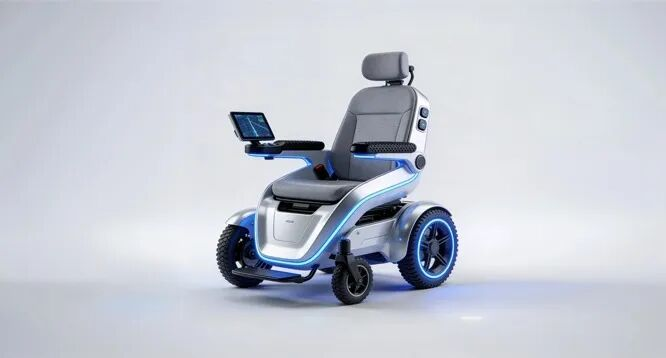
As highly dynamic autonomous mobile platforms, smart wheelchairs must fuse data from multiple sensors in real time and respond immediately. This requires hardware with high performance, high integration, and robust AI processing capabilities. The Qiyang RK3576 SoM, with its high compute power and abundant I/O, can fulfill the entire perception-decision-actuation chain, making it an ideal choice for smart wheelchair controllers.
(18).jpg)
The Qiyang RK3576 SoM's 4×Cortex-A72 + 4×Cortex-A53 big.LITTLE architecture handles multiple tasks simultaneously—environmental perception, path planning, voice control, etc.—while providing efficient compute support for complex algorithms such as real-time image processing and deep learning inference, ensuring efficient operation in complex scenarios.
The integrated 6 TOPS NPU supports TensorFlow and PyTorch, enabling YOLO-based object detection to identify pedestrians, steps, and obstacles in real time, assisting path planning and automatic deceleration or obstacle avoidance. Additionally, RK3576 supports PDM digital microphone arrays, and its 6 TOPS AI compute allows local deployment of intelligent voice applications, enabling precise voice control for users with limited hand dexterity.
Support for triple camera inputs allows deployment of forward-facing stereo vision and rear-facing anti-collision cameras, fusing multi-angle visual information for comprehensive environmental perception. The built-in 16MP ISP with hardware HDR and 3DNR pre-processes camera data in real time, providing high-dynamic-range, low-noise image inputs for improved obstacle detection accuracy and driving safety.
Support for MIPI-DSI, eDP, and HDMI display interfaces allows connection to high-brightness large screens showing simple status indicators (battery level, speed). Optional external 5G and Wi-Fi modules enable alert notifications to be sent to designated contacts in emergency situations. Onboard MIPI-CSI, CAN, USB, RS485, and I2C interfaces accommodate cameras, motor drives, sensors, and other peripherals.

