

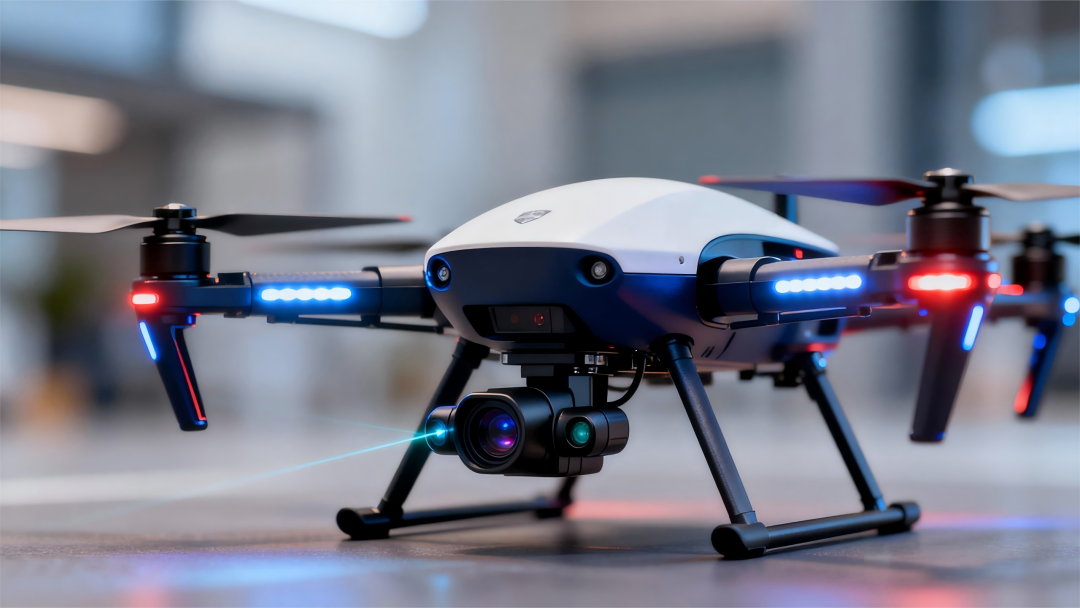
With rapid technological development, drones are increasingly being applied across various fields. In law enforcement, drones leverage their unique advantages of “high-altitude perspective, real-time response, and intelligent analysis” to greatly enhance the efficiency and safety of inspection and patrol operations.
Drones are controlled and managed through AI algorithms and intelligent hardware platforms. By combining sensors, intelligent video analysis, and 4G/5G connectivity, they can automatically identify targets and transmit high-definition data in real time. Equipped with audio-visual warning systems or other functional modules, drones can also perform diverse tasks such as high-altitude announcements, supporting ground patrols to carry out inspections more efficiently and accurately.
 Drones face strict constraints on payload and available space while needing to perform diverse and complex tasks. This requires the processing unit to offer high performance, high integration, and a compact form factor. It must also withstand harsh environments, including extreme temperatures, vibration, and shocks. At the same time, a rich set of interfaces is essential to support the various applications required for drone deployment.
 (3).jpg)
Drones need to analyze images and video in real time to automatically detect people and vehicles, enabling unmanned operations, autonomous patrols, and target tracking. The Qiyang IMX93 core module features a heterogeneous multi-core architecture with dual Cortex-A55 cores and a single Cortex-M33 core, delivering excellent multitasking and real-time performance. With a built-in 0.5 TOPS NPU, it is capable of performing lightweight AI processing locally, supporting on-board intelligence for autonomous drone missions.
The board offers a wide range of interfaces, including MIPI-CSI, USB, I2C, CAN-FD, and speaker audio output, allowing connection to cameras, sensors, positioning modules, speakers, and other devices. It also supports Wi-Fi and 4G modules for wireless communication, enabling remote control and management of the equipment.
The module is configured with 2GB LPDDR4 RAM and 8GB eMMC storage, with optional upgrades to 16GB or 32GB eMMC. It also supports one TF card for flexible expansion, providing sufficient memory and storage to meet applications requiring large memory and real-time responsiveness. The core module features a compact size (49mm × 35mm), low power consumption, and high integration, making it well suited for lightweight drone designs.
The core module is built with industrial-grade electronic components, capable of stable operation across a wide temperature range of -40°C to +85°C. It can maintain long-term reliable performance even in harsh and challenging environments, such as high-altitude low temperatures, strong vibrations, and shocks.

