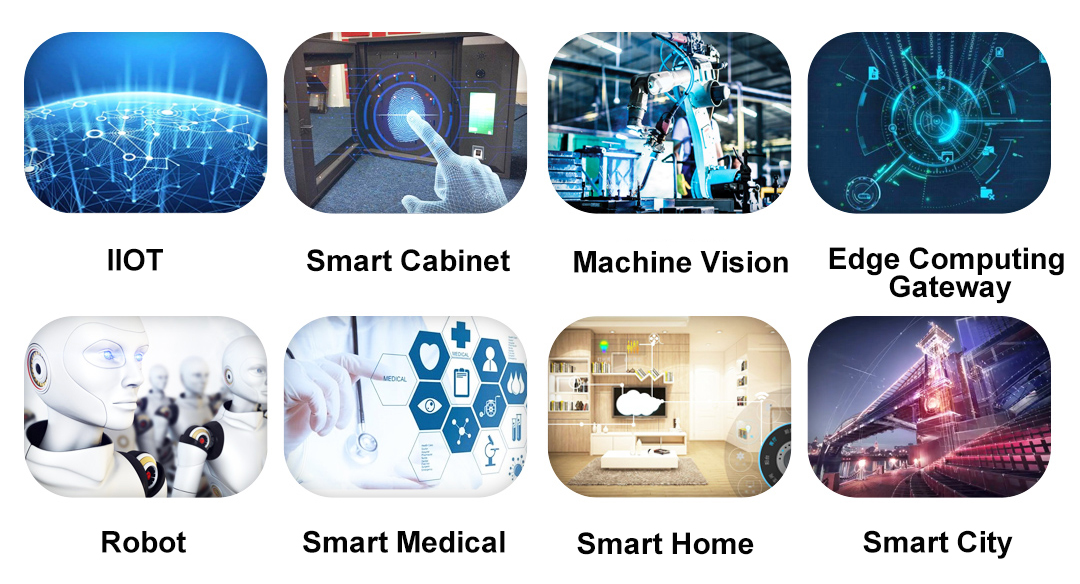
Cloud computing, edge computing and machine vision are increasingly applied in industrial and consumer systems. NXP has introduced advanced I. MX8M Plus application processor, which integrates NPU, ISP and GPU for machine learning acceleration.
IMX8MPlus is suitable for machine learning inference and various artificial intelligence on industrial and Internet of Things edges.
In order to meet the growing demands of artificial intelligence, machine vision and edge computing in various fields, Qiyang intelligence developed and launched NXP I development board--- IAC-IMX8MP-Kit based on I.MX8M Plus processor.
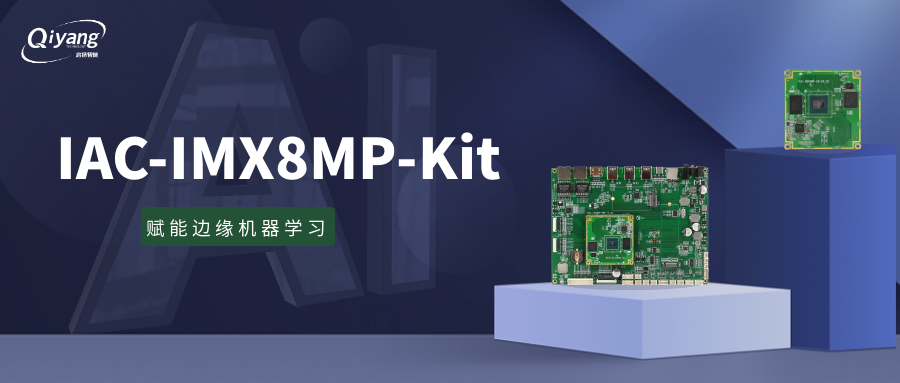
IAC-IMX8MP-Kit development board
Product introduction
Qiyang IAC-IMX8MP-Kit Development Board has a powerful processor core, a quad-core Cortex-A53 and a Cortex-M7 core, with a dominant frequency of 1.6GHz. It has a built-in NPU with a computing power of up to 2.3 TOPS, a high-precision graphics processing unit (GPU) and an image signal processor (ISP); It has advanced multimedia functions and supports multi-format 1080p @ 60 video encoding and decoding, 3D and 2D graphics acceleration, and a variety of audio and voice functions. The IAC-IMX8MP-Kit Development Board uses B TO B connectors TO connect the core board and the bottom board. The core board Integrates CPU, LPDDR4, eMMC, PMIC and other main devices. The bottom board fully expands the core resources, leading TO high-speed interfaces such as Gigabit network ports, USB3.0, Type-C, M.2, CAN-FD, and various communication and expansion interfaces. It can quickly realize AI application development in industrial interconnection, machine vision, smart city, smart home, smart medical and other.
Product Features
High-performance multi-core processor
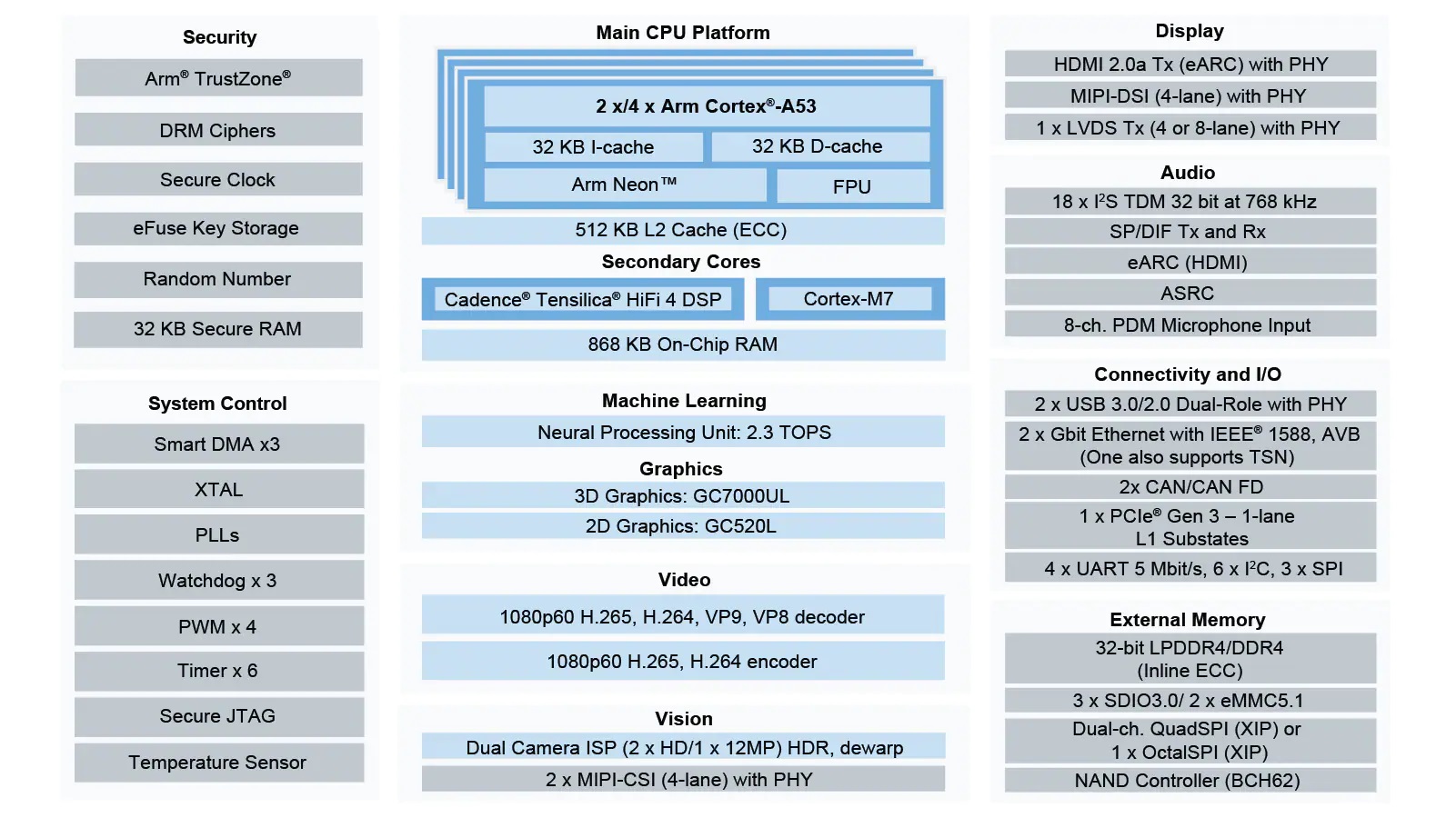 The processor carried by the development board of Qiyang IAC-IMX8MP-Kit adopts 14nm LPC FinFET technology, four cores Cortex-A53 with a dominant frequency of 1.6GHz, a Cortex-M7 real-time control core with a dominant frequency of 800MHz, advanced technology, multi-core heterogeneous and real-time operating system kernel, which further optimizes energy consumption while improving performance;
Built-in neural processing unit
Built-in neural processing unit NPU for machine learning acceleration, computing power up to 2.3 TOPS, edge localization operation processing machine learning inference, support target classification, target detection, target recognition, scene segmentation, and other machine vision processing tasks;
NPU supports models such as Tensorflow-lite, armNN, ONNX, and PyTorch, allowing you to quickly deploy models to embedded hardware platforms to help implement AI applications.
Integrated dual image signal processor
Integrated with a dual ISP, the input rate is up to 375m pixels/s, and the resolution is up to 12MPix/s. It supports simultaneous input by dual cameras; Supports processing complex image processing tasks such as fast multiple exposures and image enhancement in high dynamic range (HDR), and provides sensitive machine vision.
Rich multimedia functions
Integrated 2D/3D graphics accelerator with OpenGL support ®ES 3.1/3.0, Vulkan®, Open CL™1.2 FP and OpenVG™1.1, 1080p 60 H.265/H.264 video encoding and 1080p 60 H.265/H.264/VP9/VP8 video decoding
It has multiple display interfaces such as LVDS, MIPI-DSI, and HDMI2.0, and supports simultaneous access of three interfaces, enabling three-screen synchronous display and three-screen asynchronous display;
It integrates high-performance HiFi 4 DSP,6*SAI channels, supports I2S, AC97, TDM multi-digital audio interfaces, and supports 8-channel PDM MIC input.
Rich interfaces
High-speed communication interfaces such as 2*Gigabit network ports, 3*USB3.0, 1*Type-C, 2 M.2 (one external SSD module, one external 4G/5G module), and 2*CAN-FD are drawn out to realize efficient and smooth data transmission;
On-board Wi-Fi module, 4*RS232, 1*RS485, MIPI-DSI, LVDS, HDMI, I2C, GPIO, SIM and other interfaces, the core resources are comprehensively drawn out, and the scalability is strong, meeting the interface requirements of products in various fields.
Industrial-level characteristics
Provide error correction code (ECC) function suitable for internal memory and DDR interface, greatly reduce soft error rate (SER), industrial-grade design, temperature range from -40℃ ~ + 85℃, meeting the high quality and reliability requirements of industrial applications;
Integrated Time Sensitive Network (TSN), precisely controlled Ethernet data transmission, real-time control Cortex-M7 the kernel, dual-CAN-FD high-speed interface, support low-latency communication in industrial networks.
As a Gold Partner of NXP, the stable supply cycle is up to 10-15 years.
Operating system
Supports Linux 5.10.35 and Android operating system.
Application fields